

Are you worried about your equity investments? If so, you are not alone. Most investors would welcome a way to reduce uncertainty about the future of their portfolios.
Sellers of annuities understand this well, so they emphasize the promise of guaranteed income for life. But annuities come with a long list of problems, including large commissions, steep surrender penalties, and highly complex structures. And they are not truly “guaranteed,” because payments depend on the financial strength of the issuer. There is no absolute certainty that the company selling an annuity today will be able to meet all of its obligations 20 or 30 years from now.
The investments that come closest to being truly guaranteed are U.S. Treasuries, which are backed by the full faith and credit of the U.S. government. Major credit-rating agencies, oddly, don’t seem convinced. Moody’s and Standard & Poor’s rate U.S. government debt Aa1 and AA+, respectively, one notch below their highest ratings.
It is remarkable that these agencies rate companies such as Microsoft and Johnson & Johnson higher than the U.S. government. This suggests that the lower rating is more of a protest rating at the rapid growth of federal debt. The United States is not likely to default as those companies simply because it can print the money to pay off those obligations, while a private company cannot. Of course, excessive money creation could sharply debase the dollar, but that would also apply to any payments made by a private company.
U.S. Treasuries, therefore, go a long way toward reducing credit risk. I have also written extensively about how buying individual bonds and holding them to maturity can substantially reduce market risk. For investors focused primarily on preserving nominal capital, holding U.S. Treasuries to maturity is about as close to a low-risk strategy as it gets.
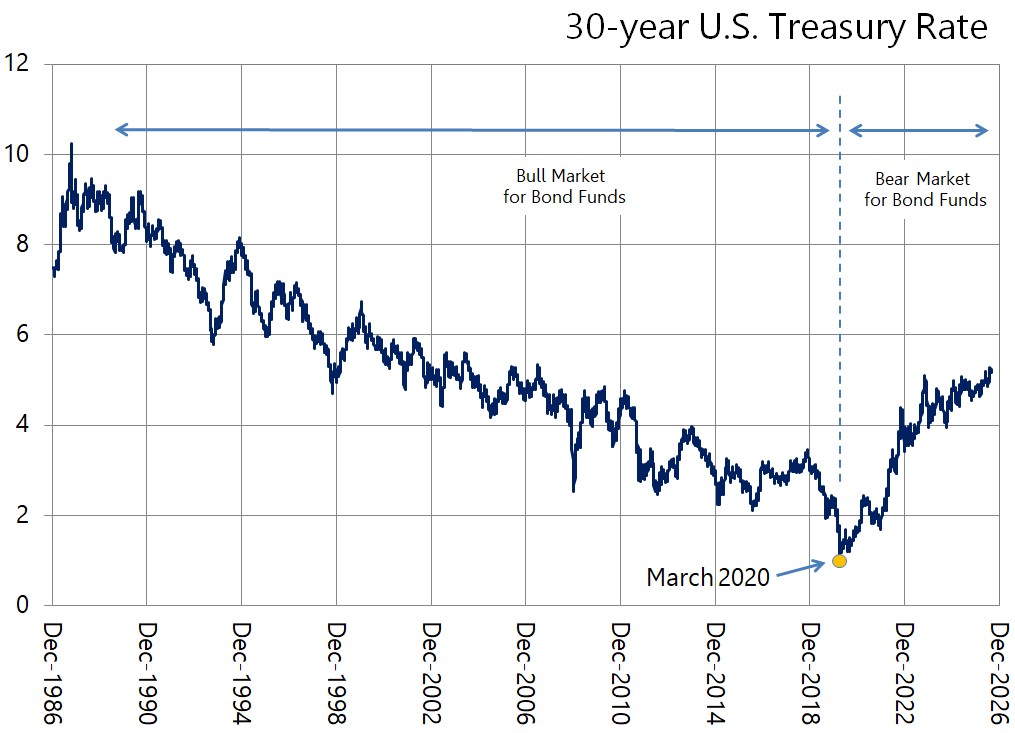
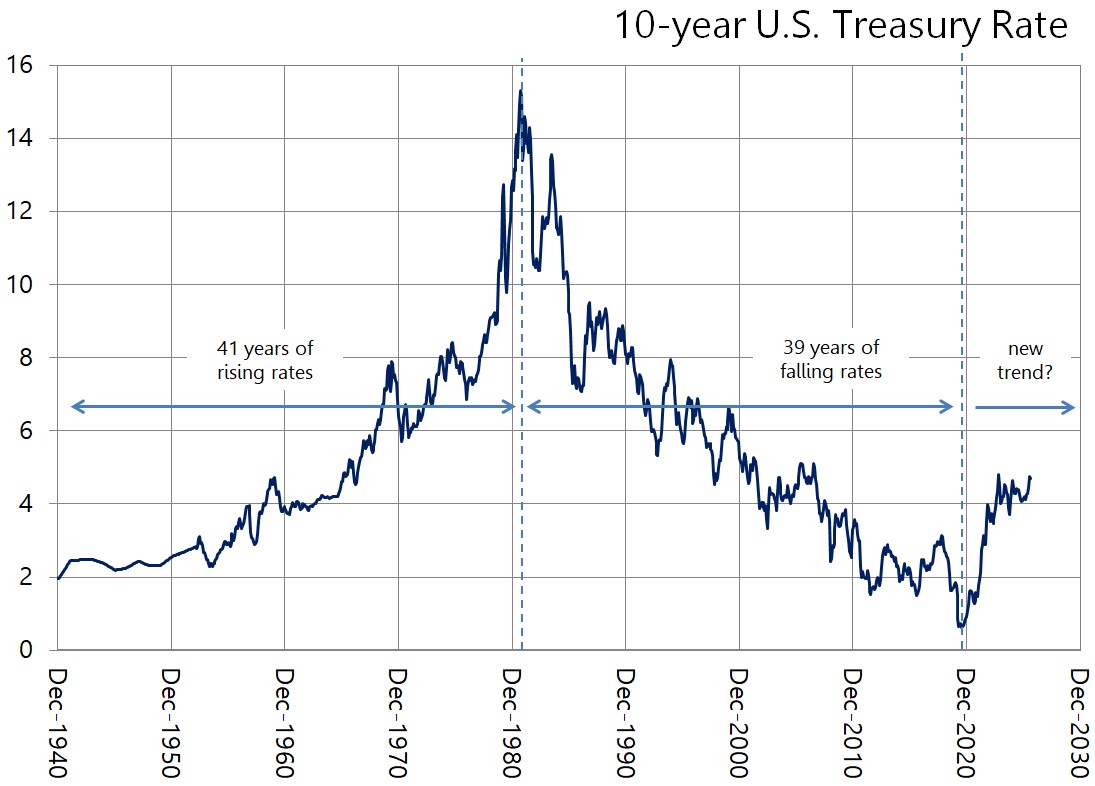
Another important point is that long-term U.S. Treasury yields have been climbing. The 30-year Treasury recently reached its highest yield since 2007, in a reversal of a 39-year decline since 1981. Some analysts attribute this reversal in part to the rapid accumulation of federal debt, which requires an ever-larger supply of Treasuries to finance government borrowing.
Whatever the reason, interest rates have historically moved in very long secular cycles. According to data compiled by Yale professor Robert Shiller, rates rose steadily over roughly 35 years from a low in the mid-1940s before beginning a prolonged decline after 1981. We may now be in the early stages of another long-term period of rising rates.
What does this mean for investors?
For decades, the traditional approach of dividing a portfolio between conservative and aggressive assets worked well for many savers. Bond funds were major beneficiaries of that environment. Coupon payments were relatively high in the early years, and bond prices rose as interest rates declined.
It is telling that one of the longest-running U.S. Treasury bond funds was launched in 1986. Vanguard’s Long Term Treasury Fund (VUSTX) delivered an average annual total return of 8.4% during the great bond bull market from 1987 through 2020, according to Morningstar data. During the following five years, however, its average annual return was negative 6.4%. Volatility also increased, from about 11% to 14%.
The reason is straightforward. Bonds in funds like VUSTX portfolio benefited from falling rates, and in the earlier years those bonds also carried high coupon payments as a result of higher prevailing rates. In contrast, many bonds currently held by funds have been issued with much lower coupons which are more sensitive to rising yields. It can take years for a bond fund’s portfolio to turn over sufficiently for newly issued, higher-coupon bonds to offset those price declines.
If the four-decade decline in interest rates has indeed ended, bond funds may face a much more difficult environment than the one that aided them for so long. Investors seeking a genuinely conservative allocation may increasingly need to consider individual bonds that can be held to maturity, which provide greater certainty about principal repayment along with predictable income.
One segment of the U.S. Treasury market is particularly worth examining: Treasury zero-coupon securities. These instruments are created by separating the coupon and principal payments of conventional Treasury bonds and selling them individually. A zero-coupon Treasury makes no periodic interest payments. Instead, like a U.S. Treasury bill, it is purchased at a discount to its face value and matures at par.
For maturities of around 15 years, for example, these instruments currently offer an annualized yield of roughly 5.3%. That is one of the highest U.S. Treasury yields available and it reflects the higher yields in the long-maturity areas of the Treasury curve. This might be a sign that a new multiyear shift in the interest rate environment is taking shape. The relentless growth of sovereign debt, both in the United States and around the world, may be the reason behind a long-term upward pressure on borrowing costs.
Higher rates would pose a challenge for investors who have grown accustomed to relying on bond funds for the conservative portion of their portfolios. If the secular interest-rate environment has truly changed, they may need to rethink that approach and consider individual bonds held to maturity as a better way to pursue long-term capital preservation and predictable returns.